GenAI & LLMs · August 2026
Building AI agents: from loops to teams
A self-contained learning guide for understanding, designing, evaluating, and operating AI agents and agentic workflows—from the first tool call to multi-agent production systems.
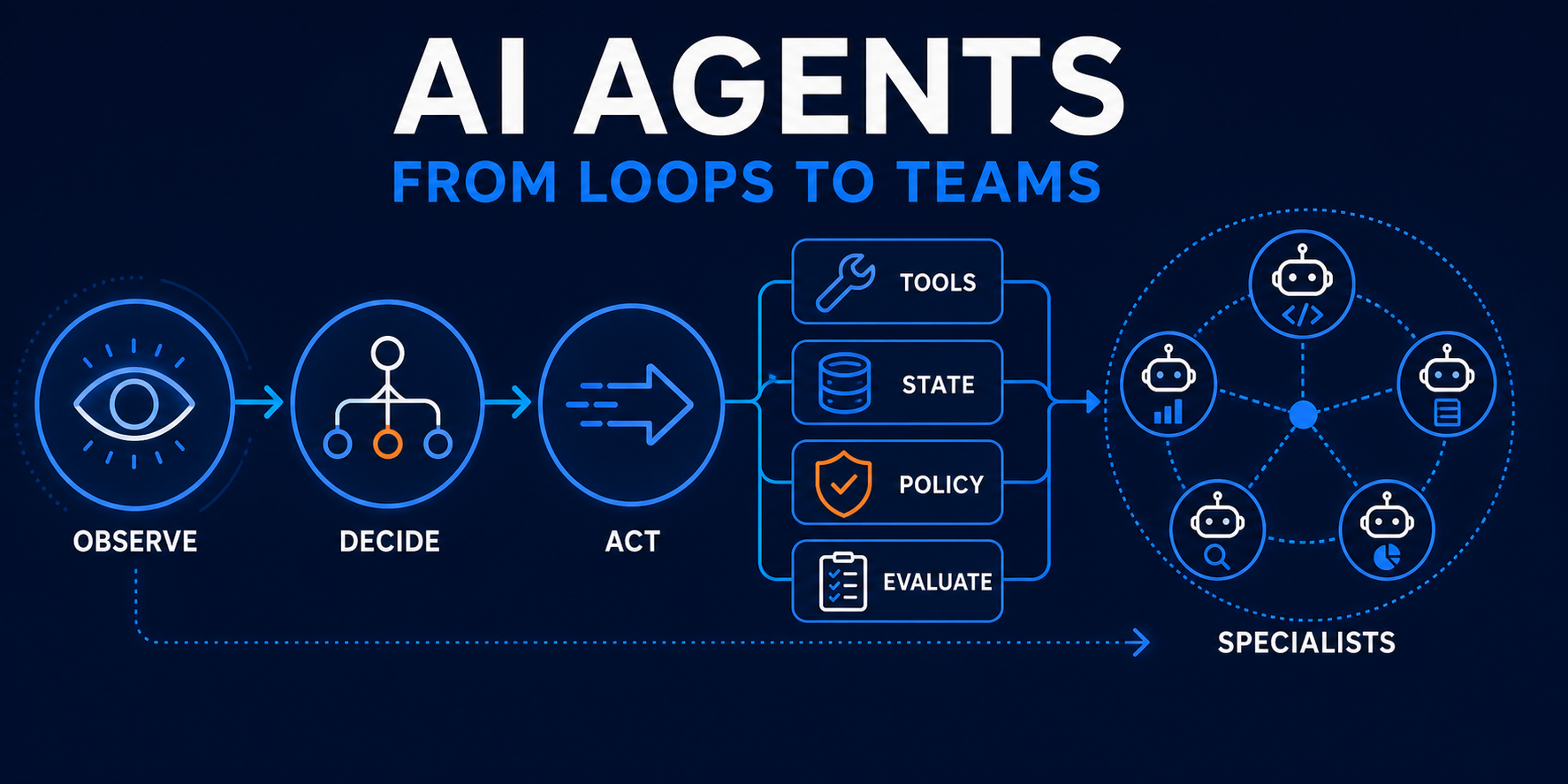
AI agents are moving from intriguing demonstrations into research, support, coding, analysis, and operations. But an agent is more than a language model with a prompt. It combines a model with instructions, tools, state or memory, and a control loop that lets it observe results and decide what to do next. The engineering challenge is to make that flexibility useful without making behavior impossible to understand or control.
This guide is designed as a self-contained learning material. It explains the core vocabulary, the design decisions behind agentic systems, the practical trade-offs between workflows and agents, the risks that appear in production, and the evaluation habits that keep teams honest. It also links to the Awesome AI Agents repository and Learning Hub for labs, notebooks, quizzes, architecture examples, and deeper reading.
What makes something an agent?
A useful agent has five ingredients. The model provides reasoning and language capability. Instructions define role, scope, and style of judgment. Tools let the system inspect or change the outside world. State and memory preserve context across steps or sessions. The control loop decides whether to answer, call a tool, ask for help, retry, stop, or escalate.
- Model: interprets the task, reasons over context, and produces decisions or language.
- Instructions: define the agent role, boundaries, tone, policies, and refusal behavior.
- Tools: expose bounded operations such as search, retrieval, database reads, ticket creation, or code execution.
- State and memory: carry useful context within a run and, when appropriate, across future runs.
- Control loop: decides what to do next, when to stop, and when to ask for human help.
That definition matters because it separates “agent” from “chatbot” and from “automation.” A chatbot may answer from context without taking action. A deterministic automation follows known steps. An agentic system can choose among possible next steps, which makes it more flexible and also harder to test. The goal is not maximum autonomy; the goal is useful autonomy inside clear boundaries.
First understand the agent loop
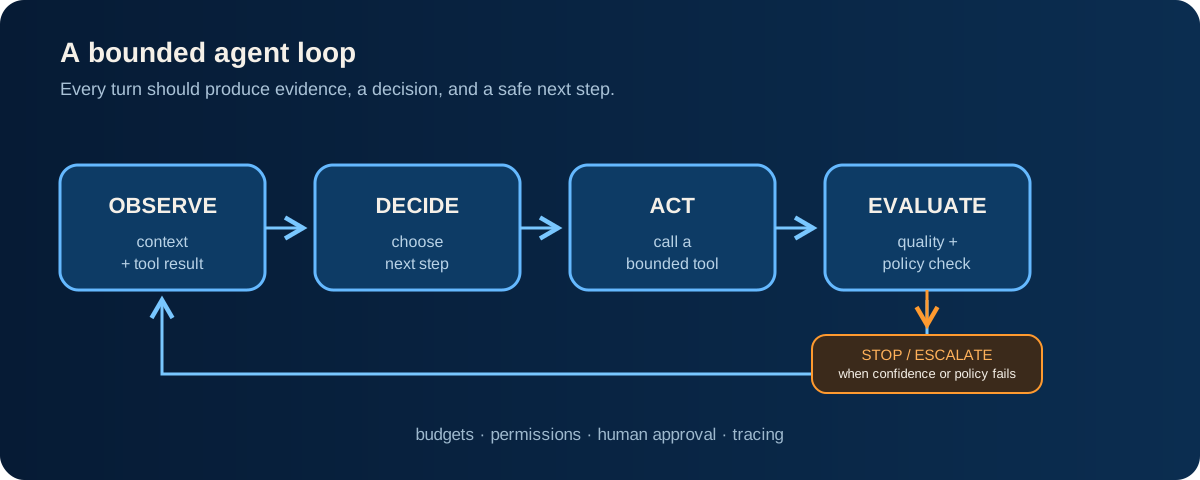
A useful mental model is observe -> decide -> act. The agent receives a goal and context, chooses whether to answer or call a tool, observes the result, and continues until it reaches a success condition, a safe stopping point, a budget limit, or a human escalation. Production systems add policy checks, tracing, evaluation, and explicit handling for uncertainty and failure.
The loop should be bounded before it becomes clever. Define what success looks like, what evidence is required, which tools are allowed, how many steps the agent can take, which failures are retryable, and when a person must review the task. Without these limits, a prototype can look impressive while quietly accumulating cost, latency, repeated calls, weak evidence, and unsafe side effects.
Read the loop like a reviewer
Every answer should be traceable to context, tool output, retrieved evidence, or an explicit assumption.
Tool choice, refusal, retry, and escalation should be explainable from the task and policy.
A bounded loop has success, budget, uncertainty, policy, and human-review stop conditions.
The building blocks of an agent
The repository organizes the core components into model, instructions, tools, state and memory, control loop, guardrails and permissions, and evaluation and tracing. Each component creates a design decision: which context is authoritative, which operations are typed and validated, what state can persist, who owns an action, and how the team will know whether the task was actually completed.
A practical design review should ask: What task is the agent responsible for? What information may it read? What action may it take? What should it never do? What should it do when the request is ambiguous? What is stored after the task completes? What evidence must be shown to a human? These questions are more important than choosing a framework too early.
Agent or workflow? Choose the least autonomy that works
A deterministic workflow is often the right starting point when the steps are known. An agentic workflow is useful when a few decisions require model judgment but the overall path can remain bounded. A single agent fits open-ended tool use; a multi-agent system may help when work separates naturally into roles or contexts. More autonomy also means more states, costs, failure paths, and evaluation work. The repository recommends justifying additional autonomy with representative evidence rather than demo appeal.
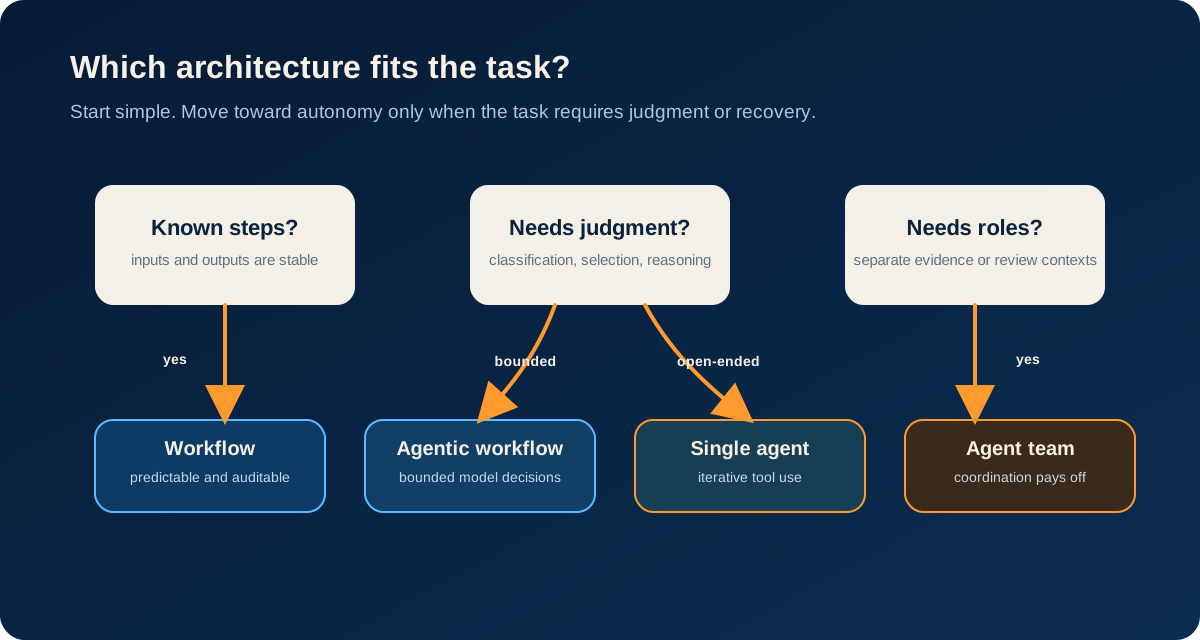
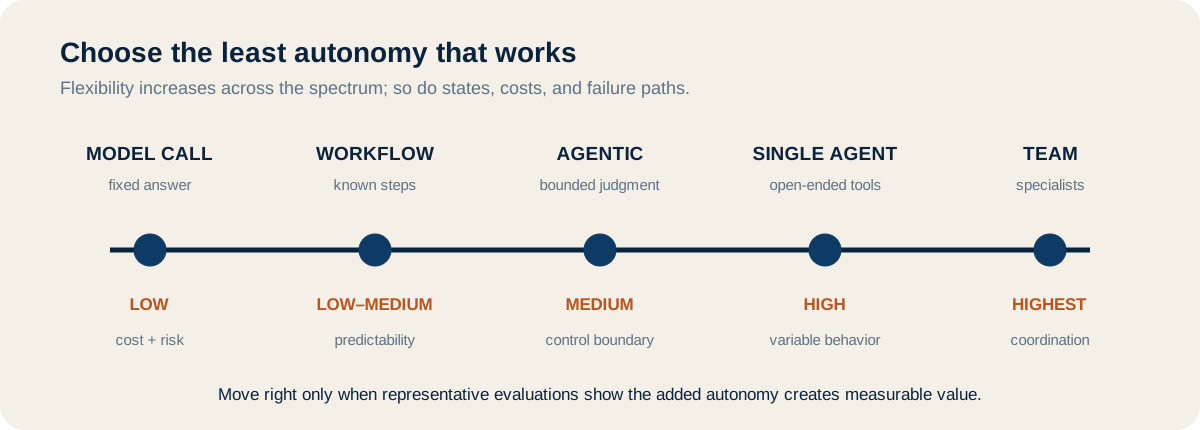
| Pattern | Use it when | Watch for |
|---|---|---|
| Deterministic workflow | The steps, inputs, and outputs are known. | Brittleness when requests vary or require judgment. |
| Agentic workflow | A few steps require model judgment, but the path can stay bounded. | Hidden autonomy if policy checks are vague. |
| Single agent | The task needs flexible tool use and iterative recovery. | Long loops, unnecessary tool calls, and weak stop rules. |
| Multi-agent team | The work naturally separates into roles, contexts, or review functions. | Coordination overhead and compounded failure modes. |
Optimize for the shortest reliable trajectory
A successful answer is not enough if it took twenty unnecessary tool calls, exposed sensitive context, or left side effects half-complete. Treat the trajectory—the sequence of model decisions, tool calls, observations, retries, and approvals—as a first-class design object. Remove avoidable steps, cache stable retrievals, constrain tool choice, and make recovery explicit. The best architecture is usually the one that reaches a trustworthy outcome with the fewest opportunities for drift.
For example, a customer-support agent should not browse every knowledge source on every request. It can first classify the request, retrieve the most relevant policy or product documentation, call a narrow account-status tool only when permission allows, draft the response with citations, and escalate when the request involves refunds, legal risk, or missing information. The lesson is simple: design the path, not just the prompt.
Benchmarks are signals, not substitutes for your workload
Public benchmarks help compare capabilities, but they rarely capture your data, permissions, latency budget, failure costs, or definition of “done.” Build a small representative task suite from real (sanitized) requests. Include happy paths, ambiguity, missing data, adversarial instructions, permission denials, and partial tool failures. Track both quality and the path taken so a model upgrade cannot quietly trade correctness for extra spend or risk.
A progression from beginner to advanced
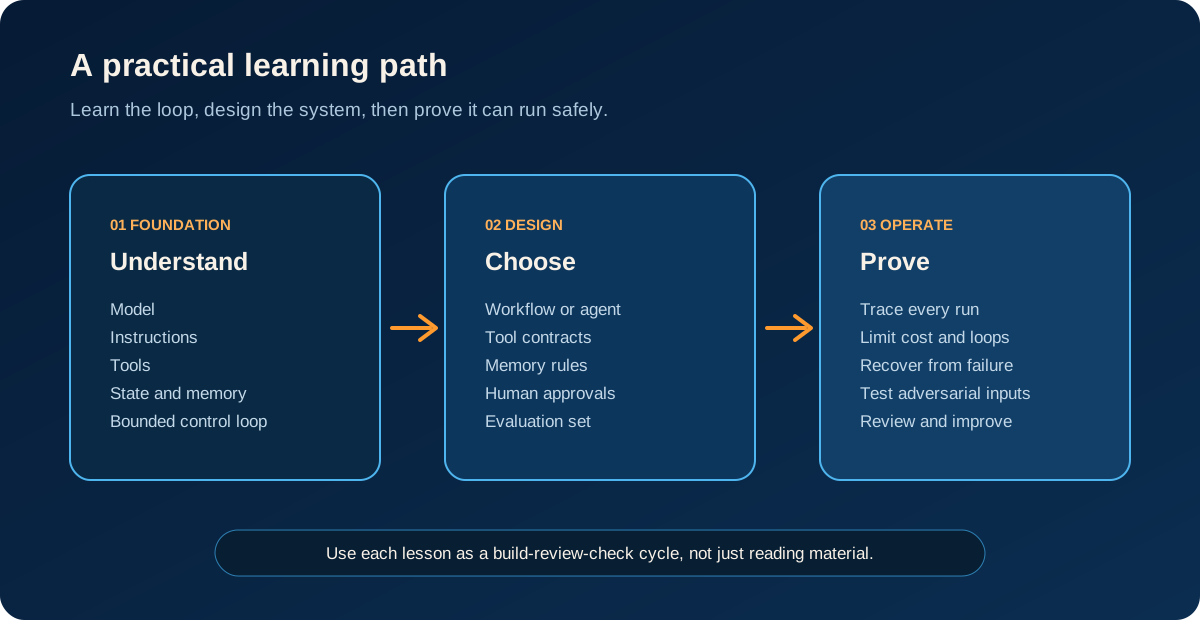
The Learning Hub follows three levels. Beginner lessons cover the agent loop, tool contracts, state, memory, safe stopping, and a research-assistant capstone. Intermediate work compares workflows and agents, introduces architecture patterns, and adds evaluation and support-workflow gates. Advanced material covers multi-agent teams, durable recovery, protocol boundaries, safety readiness, and a research-team capstone.
- Beginner goal: build the vocabulary and run a small assistant with bounded tools.
- Intermediate goal: compare architectures, add approval gates, and write task-level evaluations.
- Advanced goal: design multi-agent coordination, recovery, safety boundaries, and operations.
Build with small, testable tools
A tool is a privileged interface, not merely a function the model can discover. Good tools have narrow responsibilities, typed schemas, unambiguous names, useful errors, idempotency where possible, and explicit risk metadata. Start with deterministic stubs and read-only operations. Add provider integrations, writes, and external side effects only after policy and evaluation tests are in place.
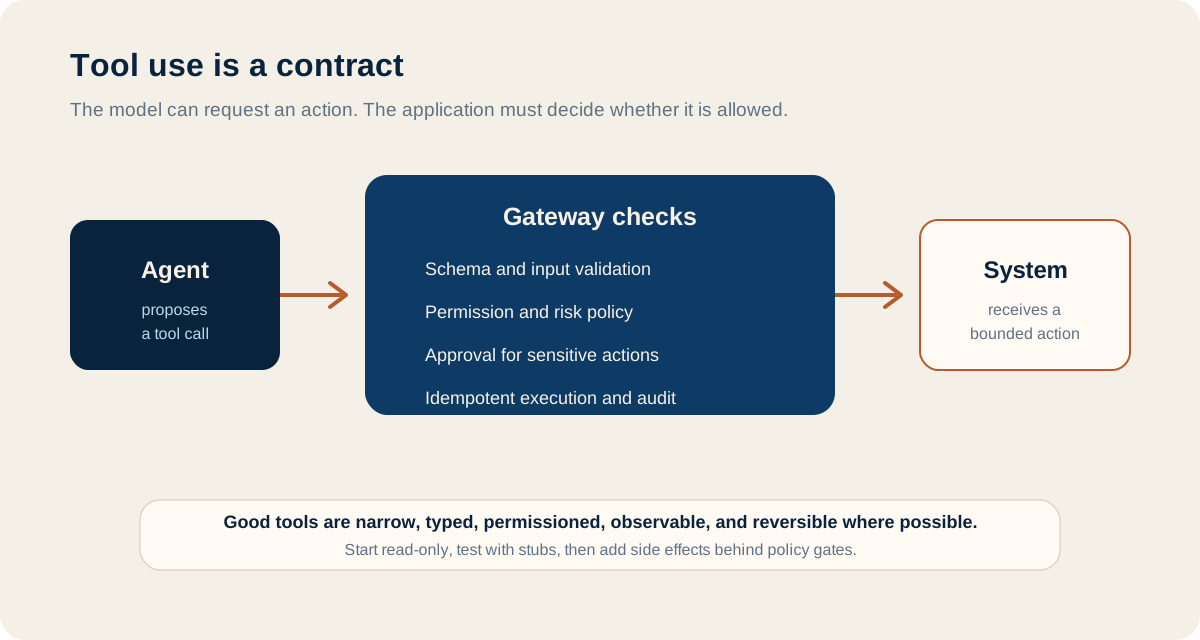
| Tool design question | Practical rule |
|---|---|
| What does the tool do? | Give it one clear responsibility and a name the model cannot confuse. |
| What inputs are allowed? | Use typed schemas, defaults, limits, and validation in application code. |
| What can go wrong? | Return explicit, recoverable errors instead of vague failures. |
| Can it change the world? | Require approval, idempotency, and audit records for write actions. |
| Who may call it? | Enforce identity and permissions outside the prompt. |
A minimum viable agent design
A useful first implementation is intentionally small. Pick one high-value task, one user role, two or three read-only tools, one success criterion, one escalation path, and a tiny evaluation set. Instrument every step. Once the agent can complete the task reliably, add controlled writes, richer retrieval, memory, or multi-agent decomposition only when each addition improves measurable outcomes.
Minimum viable agent brief

Goal: the exact task the agent owns
Inputs: user request, trusted context, allowed files or records
Tools: narrow read-only tools first; writes behind approval
Memory: what may be stored, for whom, and for how long
Stop rules: success, uncertainty, budget, policy, or human escalation
Evaluation: representative tasks, traces, cost, latency, and safety checks
Memory and state need ownership
Separate working state for the current run from long-term memory that can influence future tasks. Long-term writes should be scoped to an identity or tenant, validated before storage, auditable, and reversible. This is both a reliability and privacy requirement: stale, incorrect, or cross-tenant memory can quietly change future behavior.
Working state is usually operational: the current goal, plan, observations, tool outputs, and partial results. Long-term memory is more sensitive: user preferences, project facts, past decisions, and reusable context. Treat long-term memory like product data. It needs consent where appropriate, retention rules, correction, deletion, authorization filters, and protection from prompt injection or poisoned content.
Architecture patterns that make trade-offs visible
The repository compares prompt chaining, routing, parallelization, orchestrator-worker, evaluator-optimizer, ReAct loops, and human approval. Each pattern has a control boundary and a failure mode. Prompt chaining can make fixed sequences legible; routing can select a specialist; parallelization can improve coverage; orchestrator-worker can decompose unknown work; evaluator-optimizer can refine outputs; and human approval can protect high-impact actions.
The pattern should match the work. Use prompt chaining when each stage has a clear input and output. Use routing when requests belong to different domains. Use parallelization when independent checks improve coverage. Use an orchestrator-worker pattern when the number of subtasks is unknown. Use an evaluator-optimizer loop when refinement is valuable and bounded. Use human approval when the action is expensive, sensitive, irreversible, or reputationally risky.
Multi-agent systems: coordination is the product
Multi-agent design is not automatically better. Teams need clear ownership, context boundaries, communication contracts, termination conditions, and a reason to split the work. Compare the team against a simpler single-agent baseline. Otherwise, coordination overhead and compounded failures can outweigh the benefits of parallelism or specialization.
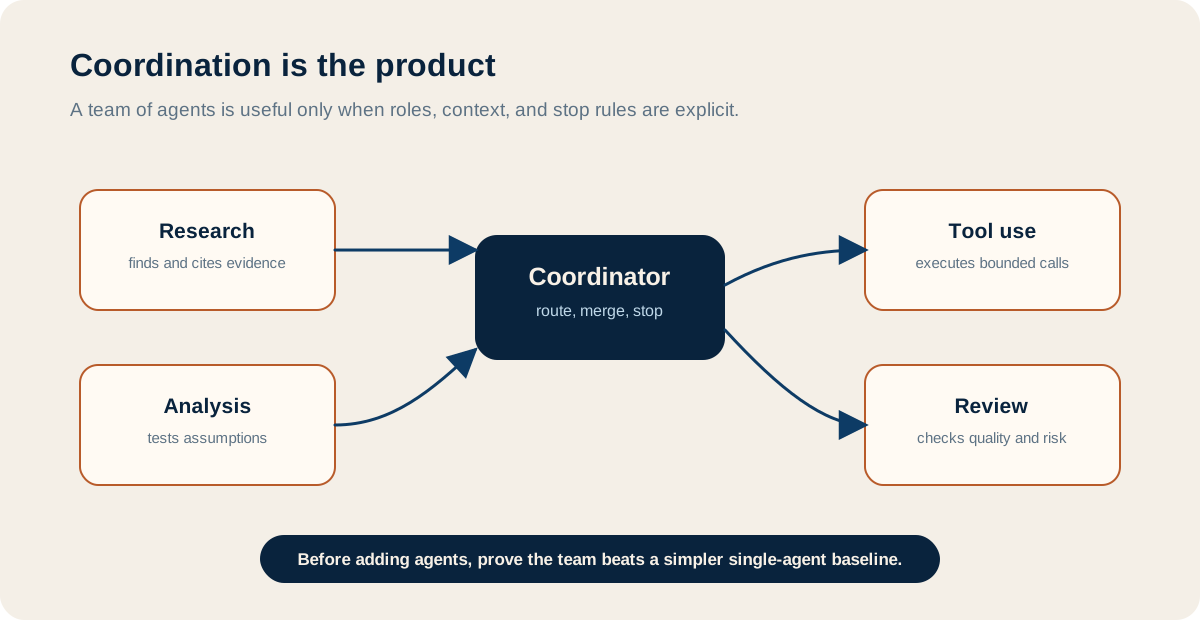
A practical team design names each role and its authority. A research agent may retrieve sources but not modify records. An analysis agent may inspect evidence and produce recommendations. A tool agent may call operational APIs through a gateway. A review agent may check completeness, risk, and policy. The coordinator should not become an invisible super-agent; it should route work, preserve context, and stop when the team is no longer making progress.
Design for cost and latency from the beginning
Agent cost is not only model pricing. It comes from repeated model calls, long context windows, retrieval and reranking, tool calls, orchestration overhead, waiting for external services, retries, and human approvals. A system that is correct but too slow or too expensive will not survive production use.
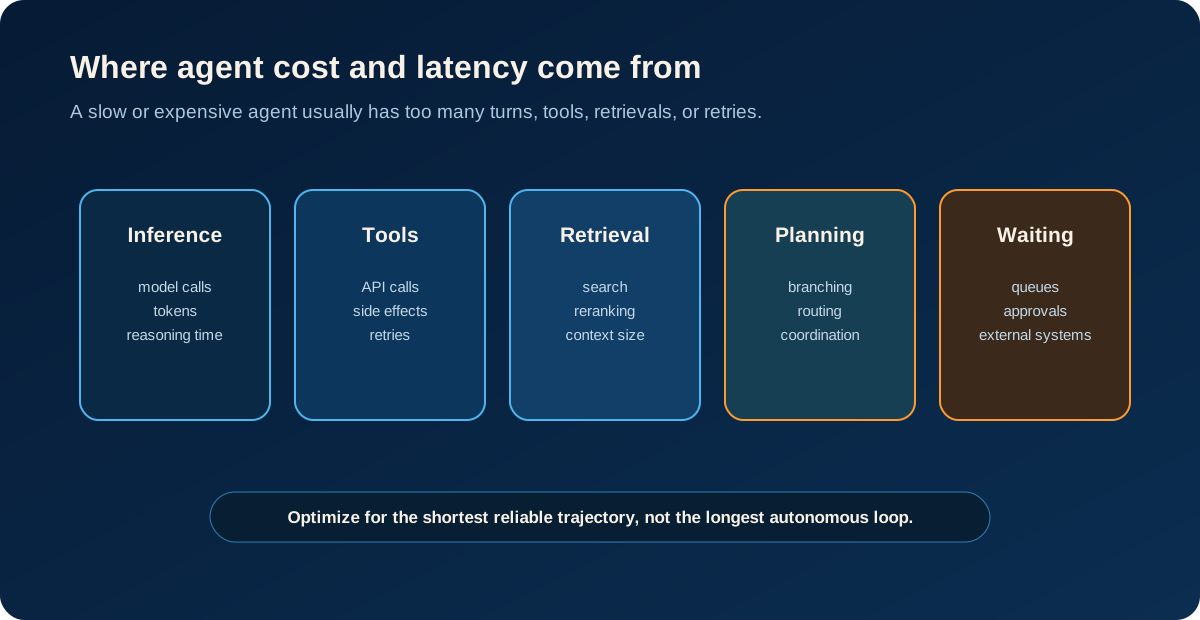
| Metric | What it tells you |
|---|---|
| Total task latency | Whether the experience is usable for the workflow. |
| LLM calls and tokens | Whether planning and context are bloated. |
| Tool and retrieval calls | Whether the agent is taking a direct path to evidence. |
| Trajectory length | Whether the loop is drifting or repeating itself. |
| Retry and escalation rate | Whether failures are understood and routed correctly. |
| Cost per successful task | Whether the agent creates durable business value. |
Evaluate outcomes, trajectories, and operations
Agent evaluation should cover more than a final answer. Measure outcome quality and policy compliance; inspect the trajectory, including tool choice, arguments, planning, grounding, recovery, and unnecessary steps; and monitor the operational envelope: latency, cost, loop length, failure rate, escalations, and side effects. The repository points learners toward task suites, graders, traces, and regression tests that resemble their actual workload.
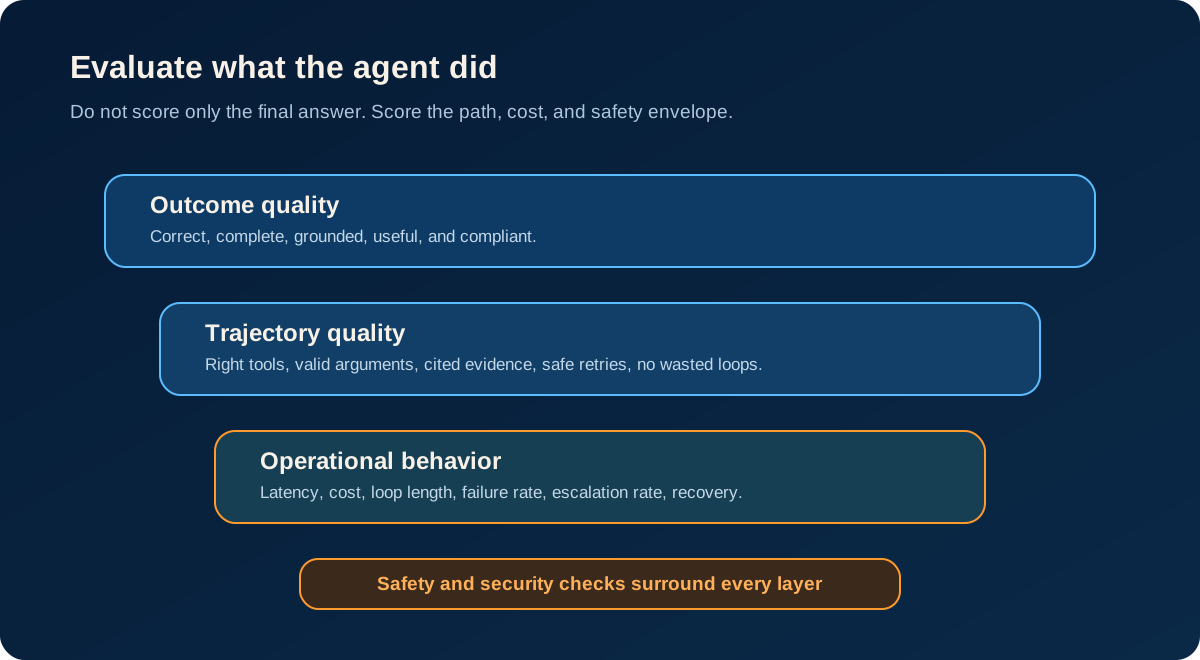
For learning and production alike, the most useful evaluations are concrete. Create twenty to fifty representative tasks before investing in a large build. Include tasks the agent should complete, tasks it should refuse, tasks it should escalate, and tasks where a tool fails. Keep traces for each run so reviewers can see not only whether the answer was right, but whether the agent used the right evidence and stopped at the right time.
- Outcome checks: correctness, completeness, citation quality, policy compliance, and user usefulness.
- Trajectory checks: tool selection, arguments, recovery, unnecessary steps, and evidence use.
- Operational checks: latency, cost, retry rate, loop length, escalation rate, and failure recovery.
- Safety checks: prompt injection resistance, permission denials, sensitive-data handling, and shutdown behavior.
Production safety is a release discipline
Before release, define success and stop conditions, time and spend limits, least-privilege credentials, validation at trust boundaries, human approval for destructive or sensitive actions, isolated execution, immutable audit records, tenant-scoped memory, idempotent writes, adversarial tests, and a kill switch. Treat user input, retrieved content, web pages, tool output, and messages from other agents as untrusted.
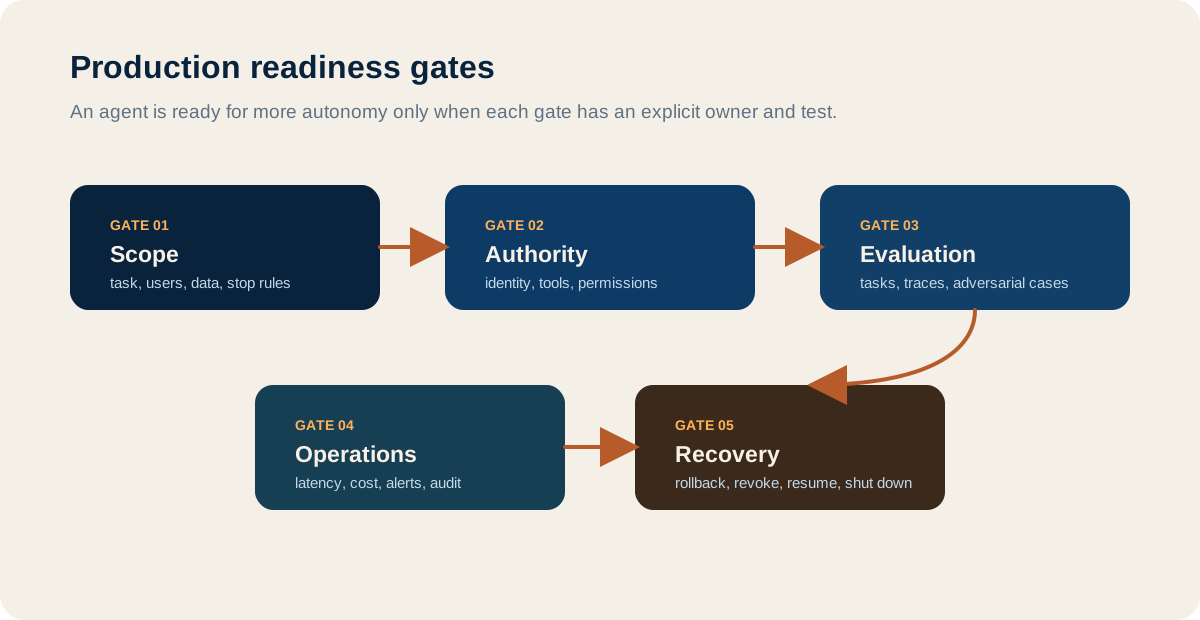
The security posture should be built into the system rather than left to prompting. Keep credentials outside the model context. Separate read and write permissions. Validate tool arguments in code. Log policy decisions. Redact sensitive data in traces. Rate-limit loops and tool calls. Test prompt injection through retrieved documents and tool outputs. Make revocation and shutdown procedures part of release readiness.
Make operations observable and recoverable
Production telemetry should connect a user goal to every model call, retrieval, tool invocation, policy decision, approval, and external side effect. Useful measures include end-to-end latency, token and tool-call counts, retrieval volume, trajectory length, retry and escalation rate, cost per successful task, and quality regressions. Redact secrets and personal data, retain enough structured evidence to replay a failure, and design resumable steps so a timeout does not require starting the entire task again.
Operationally, agents behave less like a single API call and more like a small distributed system. They wait on external services, retry, branch, recover, and sometimes need human review. Durable execution, queues, idempotency keys, correlation IDs, and structured traces are not polish; they are what let a team debug, control cost, and recover from partial failure.
A practical design exercise
Choose one workflow in your organization where people already spend time gathering information, applying judgment, and preparing an output. Write the current process as steps. Mark which steps are deterministic, which require judgment, which access sensitive data, and which create side effects. Then decide whether the first version should be a workflow, an agentic workflow, a single agent, or a team. If the answer is a team, explain why a single agent is insufficient.
A strong first use case is narrow, frequent, evidence-rich, and reviewable. Examples include drafting a policy-grounded response, summarizing a technical incident, preparing a research brief, reviewing a document against a checklist, triaging support requests, or extracting structured information from internal sources. A weak first use case is broad, ambiguous, high-risk, poorly instrumented, or dependent on undocumented tribal knowledge.
Use the course as a build-and-review loop
The Hub is designed around Learn -> Design -> Check. Read the concept and its sources, inspect the practical guide, run a lab or notebook, conduct a design review, and then test judgment with the quiz. This approach helps teams turn agent enthusiasm into shared vocabulary, explicit trade-offs, and repeatable engineering practice.
For teams, the most valuable outcome is not only a working prototype. It is a shared way to reason about autonomy, tools, memory, evaluation, and risk. That vocabulary helps leaders ask better questions, engineers design safer systems, and domain experts stay involved where their judgment matters most.
References and further learning
Awesome AI Agents repository ↗
The source learning repository behind this article, with curated topics, labs, notebooks, architecture notes, evaluation resources, and implementation pointers.
AI Agents Learning Hub ↗
A structured hub for beginner, intermediate, and advanced AI agent lessons organized around learning, design, and knowledge checks.
AI Agents Knowledge Check ↗
An 18-question quiz for testing core concepts such as loops, tools, memory, evaluation, architecture patterns, and safety.
Building AI agents: from loops to teams on LinkedIn ↗
The companion One+i post that summarizes the agent loop, anatomy, tool design, memory, multi-agent coordination, cost, latency, and production readiness.
OpenAI: A practical guide to building AI agents ↗
A practical guide for identifying agent use cases, selecting architecture patterns, and designing agents for reliable business workflows.
Anthropic: Building effective agents ↗
A clear discussion of workflow and agent patterns, including when simple deterministic structures are preferable to more autonomous systems.
ReAct: Synergizing reasoning and acting in language models ↗
The research paper that popularized interleaving reasoning traces and actions, a foundational idea behind many tool-using agent loops.
Lilian Weng: LLM-powered autonomous agents ↗
A detailed technical overview of planning, memory, tool use, and agent architectures for large language model systems.
Anthropic: Demystifying evals for AI agents ↗
A useful guide to evaluating agent behavior beyond final-answer scoring, including task design and practical evaluation workflows.
OpenAI Agents SDK: tracing and observability ↗
Documentation on tracing agent runs so teams can inspect model calls, tool calls, handoffs, and operational behavior.
LangGraph: durable execution ↗
A reference for durable agent and workflow execution patterns, including recovery from interruptions and long-running tasks.
AgentBench: evaluating LLMs as agents ↗
A benchmark paper for evaluating language models in agent-like environments that require interactive decision making.
Berkeley Function-Calling Leaderboard ↗
A benchmark focused on function calling and tool-use behavior, useful for comparing model capability in structured tool invocation.
SWE-bench ↗
A software engineering benchmark that evaluates agents on real GitHub issues, useful for understanding coding-agent performance and limitations.
WebArena ↗
A realistic web-agent benchmark for tasks that require navigation, tool use, and interaction with web environments.
NIST AI Risk Management Framework ↗
A governance framework for managing AI risks across validity, safety, security, accountability, transparency, and human oversight.
OWASP Agentic Security Initiative ↗
Security guidance for agentic systems, including threat modeling, tool risks, memory risks, authorization, and operational controls.