GenAI & LLMs · August 2026
Prompt engineering is growing up: from clever wording to reliable AI systems
A practical, self-contained guide to behavior contracts, structured outputs, context engineering, evidence retrieval, bounded tool use, decomposition, evaluation, PromptOps, and human-centred AI systems.
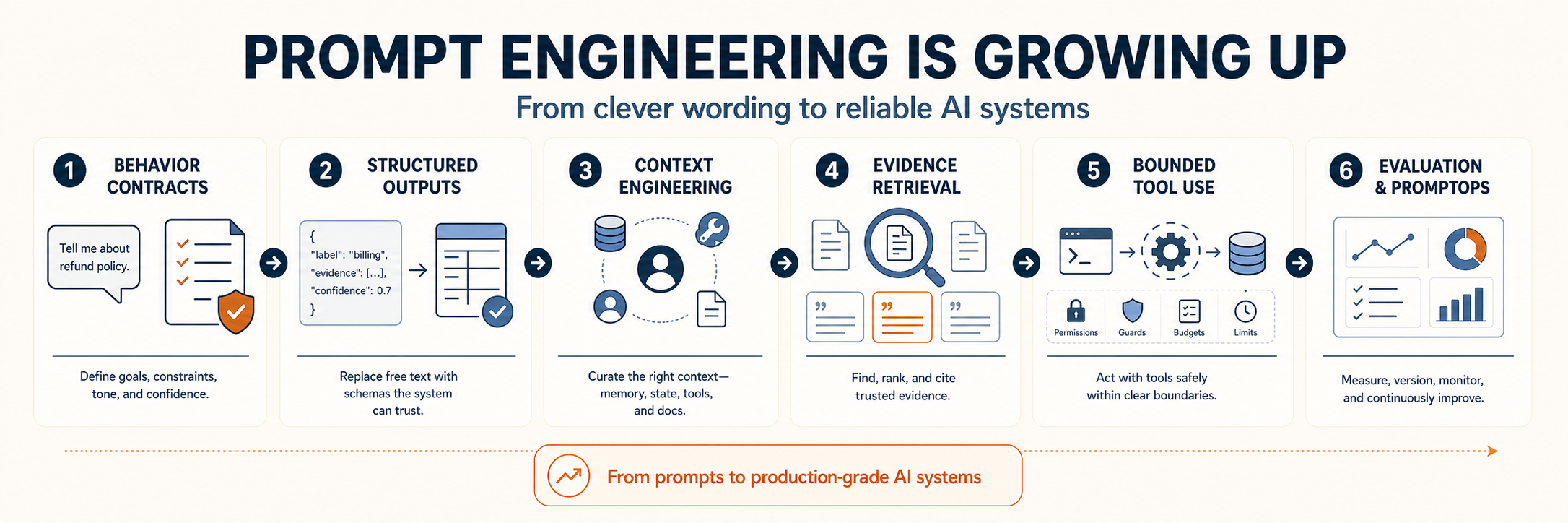
Prompt engineering began as a search for better phrases: “act as an expert”, “be concise”, “think step by step”. Those experiments were useful because they revealed that instructions influence model behavior. Production systems require a broader discipline. A modern prompt is a behavior contract: it defines the task, supplies the right context, constrains unsupported behavior, establishes an output interface, and gives the team something it can evaluate.
| Engineering decision | Support-triage choice | Evidence to collect |
|---|---|---|
| Behavior contract | Return category, urgency, rationale, citations, and confidence. | Schema-valid outputs and label accuracy |
| Context | Use current policy plus authorized order state; exclude unrelated history. | Freshness, access checks, and citation coverage |
| Action | Draft a reply; never issue credits or change an order autonomously. | Tool audit logs and approval rate |
| Escalation | Hand off low confidence, conflicting policy, or safety-sensitive cases. | False-automation rate and reviewer outcomes |

1. Prompt engineering is becoming specification engineering

A request such as “read this customer message and tell me the issue” hides decisions about labels, ambiguity, evidence, confidence, and the format downstream software expects. A production specification makes those decisions explicit: define the task, allowed values, constraints, examples, abstention behavior, and output fields. This is why prompt engineering now overlaps with product requirements, interface design, and test engineering.
- Define the task: name the decision or transformation precisely.
- Constrain behavior: state allowed sources, actions, tone, and refusal conditions.
- Show examples: include representative successes, edge cases, and counterexamples.
- Specify the interface: use typed fields, enums, required values, and validation.
- Define evaluation: decide what “good” means before tuning the prompt.
2. Structured outputs are replacing “please return JSON”

Free-form JSON requests can produce wrappers, missing fields, renamed keys, invalid enum values, or malformed syntax. Structured output features and application-side validation turn generation into a typed interface. The model should be encouraged to follow a schema, but the application must still validate, reject, retry, or escalate invalid results. Never treat a model’s formatting claim as a guarantee.
| Layer | Responsibility | Failure handling |
|---|---|---|
| Prompt | Explain the fields, semantics, and examples. | Clarify ambiguous values and instruct abstention. |
| Schema | Define types, enums, required fields, and bounds. | Reject malformed or impossible outputs. |
| Application | Validate, normalize, authorize, and persist. | Retry safely or route to human review. |
| Evaluation | Measure correctness and contract adherence. | Block regressions before release. |
3. Context engineering is overtaking prompt wording

The model’s working set may include system instructions, the user request, conversation state, approved memory, retrieved documents, tool results, and verified application state. Context engineering asks what the model should know at the moment of a decision. More context is not automatically better: useful context must be necessary, authorized, current, attributable, and bounded.

4. Retrieval is becoming evidence engineering

RAG is no longer only “question → vector search → documents → answer”. Reliable retrieval classifies the information need, applies access and freshness filters, combines dense and sparse search, reranks candidates, selects diverse evidence, preserves provenance, and validates claims and citations. The prompt should tell the model to distinguish verified facts, user statements, assumptions, and missing evidence.
- Dense retrieval: semantic similarity for paraphrases and concepts.
- Sparse retrieval: exact terms, identifiers, codes, names, and clauses.
- Metadata filters: version, owner, date, jurisdiction, tenant, and access class.
- Reranking: choose passages that answer rather than merely resemble the query.
- Abstention: return NEEDS_INFORMATION or ESCALATE when evidence is insufficient.
5. Reasoning prompting is becoming selective

“Think step by step” is not a universal reliability strategy. First identify the failure: skipped conditions, dependent subproblems, arithmetic, missing evidence, or competing plans. Use the smallest structure that fixes that failure. A checklist, decomposition, tool call, verifier, or deterministic function may be safer and cheaper than a long reasoning prompt.
6. Decomposition beats monolithic prompts

Many requests hide a workflow. A refund decision may require extracting an order ID, retrieving order state and policy, checking eligibility, identifying missing information, and explaining the result. Split at real dependency boundaries. Keep authorization, filtering, calculations, and validation deterministic; let the model handle language understanding, flexible interpretation, and explanation.
7. Models orchestrate computation; they do not replace it

Use language models for interpretation and planning, then call deterministic code for arithmetic, database updates, policy checks, and high-impact actions. Program-Aided Language Models and Program of Thoughts formalize this pattern: the model proposes executable steps, while a trusted runtime computes and verifies the result.
8. ReAct is evolving into bounded tool use

Tool-using systems follow a loop: understand the goal, select a tool, observe the result, update the plan, and stop. Production prompts must describe tool purpose, arguments, permissions, side effects, error handling, budgets, and escalation. A tool is not a suggestion box: schema validation, authorization, risk checks, and audit logging must happen before a real system is touched.
9. Tool descriptions are part of the interface

A vague tool such as lookup() creates ambiguity and unsafe choices. A good description states what the tool returns, which resources it can access, when it should be used, what it must not be used for, and examples of valid arguments. Better descriptions improve tool selection, reduce retries, and create a reviewable contract between the model and the application.
10. Agent prompting is policy design

An agent policy should define the user goal, allowed tools, permissions, stop conditions, escalation rules, data boundaries, and approval requirements. Bounded autonomy is usually more useful than unlimited autonomy: the system should know when to stop, ask, refuse, or hand off.
11. Multi-agent systems need measured specialization

Multiple agents help when roles are genuinely different, tasks can run in parallel, or independent critique improves quality. They hurt when role boundaries are unclear, coordination latency grows, failures multiply, or no measurable improvement appears. Start with one bounded workflow; add agents only when specialization solves a demonstrated bottleneck.
12. Security is inseparable from prompt engineering

Prompts are not security boundaries. Retrieved text, tool results, user content, and memory can contain instructions that conflict with system policy. Enforce security in the system: least-privilege tools, trusted-state separation, input and output validation, authorization, secret isolation, sandboxing, rate limits, audit trails, and human approval for consequential actions. Prompt injection is a reason to strengthen boundaries, not a reason to write a longer system prompt.
13. Evaluation is replacing intuition

A prompt that looks good in a demo may fail on ambiguity, adversarial inputs, long context, distribution shift, or model upgrades. Build a representative gold set, define rubrics, measure task success and safety separately, inspect failure clusters, and compare changes against a baseline. Evaluate the whole system: output quality, schema adherence, retrieval support, latency, cost, refusal behavior, and user outcomes.
14. Prompt optimization becomes search with constraints

Prompt improvement can be treated as constrained search: generate candidates, run them against a fixed evaluation set, inspect regressions, and select the best utility under quality, latency, cost, and safety constraints. Automatic optimizers are useful assistants, not authorities. Preserve human review and never optimize away a safety contract.
15. Accuracy alone is no longer enough

| Dimension | Question |
|---|---|
| Quality | Does it solve the intended task completely and faithfully? |
| Reliability | Does it behave consistently across paraphrases and edge cases? |
| Latency | Can it respond within the workflow’s deadline? |
| Cost | Does the token, retrieval, and tool budget fit the business case? |
| Risk | Does it protect privacy, safety, access, and human control? |
16. Advanced prompting is model-dependent

A prompting technique is not a law of nature. It is an interaction between a task, a model family, a model version, the decoding settings, and the surrounding context. A chain-of-thought pattern that helps one model may add noise to another; a concise schema instruction may outperform a long meta-prompt after a model upgrade. Treat techniques as hypotheses, record the model and settings, and re-run the evaluation set whenever the model changes.
| Change | What to re-check |
|---|---|
| Model or snapshot | Instruction following, schema adherence, refusal behavior, tool selection. |
| System prompt | Task success, safety boundaries, verbosity, citation support. |
| Context or retrieval | Groundedness, relevance, source coverage, token pressure. |
| Decoding settings | Consistency, diversity, latency, and cost. |
17. PromptOps is a real engineering discipline

Treat prompts like code and data together. Keep them in version control, review changes, attach a change rationale, run regression tests, compare a holdout set, deploy with a canary, monitor production, and keep rollback available. Store the prompt version beside model version, retrieval configuration, tool definitions, and evaluator results so an incident can be reproduced.

18. Human-centred prompting matters more as autonomy grows

Good systems allocate work deliberately between people and models. AI can propose while a person approves; extract while a person verifies; detect uncertainty while a person resolves it; or perform bounded work while a person controls consequential actions. Make confidence, sources, assumptions, and next actions visible. The objective is not to remove judgment—it is to help people apply judgment at the right boundary.
- AI proposes → human approves: drafts, recommendations, and ranked options.
- AI extracts → human verifies: claims, entities, clauses, and records.
- AI detects uncertainty → human resolves: ambiguity, conflicts, and missing evidence.
- AI performs bounded work → human controls consequences: sends, publishes, changes, or commits.
19. The evolution is from prompts to systems

Prompt crafting asks for better wording. Prompt engineering adds constraints and examples. Reasoning engineering adds decomposition and verification. Context engineering curates the working set. Knowledge and RAG provide attributable evidence. Tool and workflow engineering connect deterministic capabilities. Agent engineering adds bounded planning. Evaluation engineering measures outcomes. AI system engineering integrates all of these with security, observability, cost, and human control.


A practical learning path
The Prompt Engineering training repository turns these ideas into a progression from instruction contracts and examples to structured outputs, context engineering, retrieval, selective reasoning, bounded agents, security, evaluation, PromptOps, and human-centred design. Use it as self-study, a workshop curriculum, or a team design-review companion.
Explore the Prompt Engineering training repository ↗
Open the Prompt Engineering Learning Hub ↗
References and further reading
Attention Is All You Need ↗
The Transformer paper that established the architecture behind modern language models.
Chain-of-Thought Prompting Elicits Reasoning in Large Language Models ↗
Foundational research on reasoning demonstrations and why selective reasoning should be evaluated rather than assumed.
ReAct: Synergizing Reasoning and Acting in Language Models ↗
Introduces the reasoning-and-action loop that influenced modern tool-using agents.
Program-Aided Language Models ↗
Shows how language models can generate programs while external execution handles reliable computation.
Self-Consistency Improves Chain of Thought Reasoning ↗
A sampling-based approach that highlights the role of agreement and evaluation in reasoning reliability.
OpenAI Structured Outputs ↗
Practical documentation for schema-constrained model outputs and reliable application interfaces.
Anthropic: Building Effective Agents ↗
A practical guide to workflows, agents, tool design, and choosing the simplest architecture that works.
Large Language Models as Optimizers (OPRO) ↗
A research approach that uses language models to propose and improve instructions against an objective.
PromptBreeder: Self-Referential Self-Improvement Via Prompt Evolution ↗
Explores evolving task prompts and mutation prompts against measured fitness rather than relying on manual wording alone.
DSPy: Compiling Declarative Language Model Calls into Self-Improving Pipelines ↗
A framework for optimizing modular language programs and treating prompts as components of a larger system.
Effective context engineering for AI agents ↗
Current practical guidance on designing the smallest sufficient working context for capable agents.
Demystifying evals for AI agents ↗
Explains why agent evaluations should inspect trajectories, tool calls, and intermediate decisions.
OpenAI Prompt Engineering Guide ↗
Practical guidance on instructions, message roles, examples, and iterative prompt development.
NIST AI Risk Management Framework ↗
A risk-management foundation for trustworthy, accountable, and human-centred AI systems.
OWASP Top 10 for LLM Applications ↗
Security risks and mitigations for prompt injection, insecure outputs, data leakage, and tool misuse.
Prompt Engineering Repository and Learning Hub ↗
Practical lessons, labs, examples, and exercises for applying the ideas in this article.